Physical Address
304 North Cardinal St.
Dorchester Center, MA 02124
Physical Address
304 North Cardinal St.
Dorchester Center, MA 02124

This book is perfect for:
✨ In short: If you want to get more done by feeling better, not by grinding harder, this book is for you.
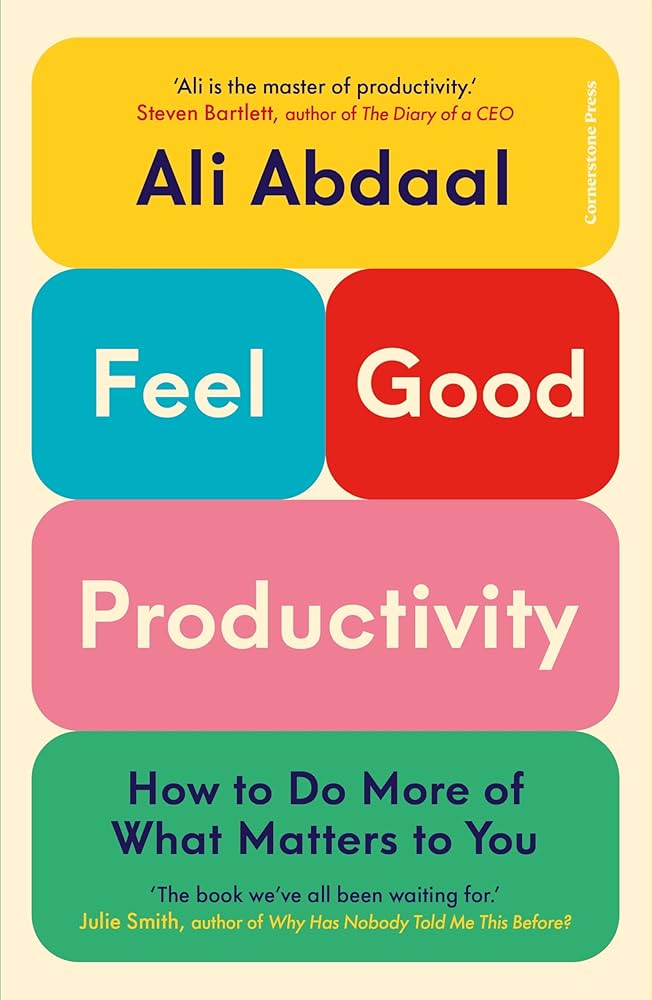
Feel Good Productivity challenges the conventional wisdom that productivity is all about discipline, hustle, and sheer willpower. Instead, Ali Abdaal proposes a more human, science-backed approach: when we feel good, we naturally perform better. The book blends psychological research, neuroscience, and Abdaal’s personal journey—from working as a doctor to becoming a successful entrepreneur and creator—to show that joy and fulfillment are not luxuries, but the very engines of sustainable productivity.
Central to Abdaal’s message is the connection between positive emotions and performance, grounded in the role of four key “feel-good hormones”:
By understanding and intentionally cultivating these chemicals through our daily choices—whether through exercise, meaningful work, social interaction, or small wins—we can design an environment that fuels both happiness and output.
Abdaal dismantles the myth that the only path to achievement is relentless grind. He argues that productivity is not about doing more for the sake of it—it’s about doing more of what matters, in a way that feels energizing rather than depleting. One of his key strategies is time blocking, which functions much like budgeting money: by deliberately assigning time to specific tasks, you free yourself from constant decision-making and ensure your priorities are met. He emphasizes the importance of clarity, noting that if you don’t know when you’ll do something, chances are you won’t do it.
The book is filled with practical mindset shifts. For example, adopting the attitude that “no one cares” can be liberating—it reduces the fear of judgment that often holds us back. He also encourages readers to “make a start” without obsessing over perfection, because momentum matters far more than flawless beginnings. Taking ownership of your process, even when you can’t control the outcome, keeps you moving forward regardless of external circumstances.
Another major theme is the power of subtraction. By removing unnecessary commitments and focusing on fewer, high-impact activities, you create space for creativity, deeper thinking, and genuine enjoyment. This minimalistic approach not only boosts efficiency but also prevents burnout.
Throughout the book, Abdaal reinforces that productivity is not just a work concept—it’s a life concept. Feeling good leads to doing good work, which leads to a greater sense of accomplishment, which in turn reinforces feeling good. This positive feedback loop creates a sustainable rhythm that supports both personal and professional goals.
The lessons are illustrated with engaging stories, relatable struggles, and clear frameworks. The tone is encouraging and practical, making the concepts easy to apply in real life. Readers walk away with tools to improve their focus, strategies to design their day around energy rather than obligation, and a mindset that prioritizes joy as a legitimate productivity strategy.
In the end, Feel Good Productivity is both a manifesto and a manual. It’s a reminder that the ultimate measure of productivity isn’t how much you do, but how deeply your actions align with what matters to you—and how good you feel while doing it. By shifting from a grind mindset to a growth-and-joy mindset, you can achieve more, sustain your momentum, and actually enjoy the process of building the life you want.
“Step one is feeling better. Step two is doing more of what matters to us.”
“When we can’t take ownership of the situation, we can still take ownership of the process.”
“Such environments encourage people to see their lives as a zero-sum game: for them to win, others have to lose.”
“When you want to succeed as badly as you want to breathe, then you’ll be successful.”
“If you don’t know when you’re doing something, chances are you won’t do it.”
“And just like monetary budgeting can give you financial freedom, time blocking can give you time freedom.”
“Make a start. You won’t need to get perfect for a long time yet.”
“The mindset of ‘no one cares’ can be totally transformative.”
“An object at rest stays at rest, while an object in motion stays in motion, unless acted on by an external imbalanced force.”
“Do less so that you can unlock more.”
✨ In short: This book works because it’s not about doing more for the sake of more—it’s about doing the right things in a way that feels energizing and sustainable.
Before reading this book, I thought productivity meant pushing myself harder—longer hours, tighter schedules, and constant pressure. Sure, I was ticking boxes… but I was also running on fumes. My work felt mechanical, my creativity was drying up, and even my “free time” felt rushed.
Then I read Feel Good Productivity, and it flipped my mindset completely. Ali Abdaal’s simple idea—that joy fuels achievement—made me realize I didn’t need more discipline, I needed more delight.
Here’s what shifted for me:
Now, productivity isn’t about squeezing out more work—it’s about building a life where work and joy feed each other.
Feel Good Productivity isn’t just another productivity book—it’s a permission slip to stop grinding yourself into the ground and start creating a life that’s both meaningful and enjoyable.
Ali Abdaal’s approach reminds us that we don’t have to choose between feeling good and getting things done—in fact, the two feed each other. By focusing on joy, energy, and alignment with what truly matters, productivity becomes less of a chore and more of a natural outcome.
If you’ve ever felt that traditional hustle culture leaves you drained, this book offers a gentler, smarter alternative—one that’s sustainable for the long game. And once you experience how good productivity feels, you’ll wonder why you ever settled for anything less.