How to Change Your Financial Life – Cody Sanchez
Takeaways
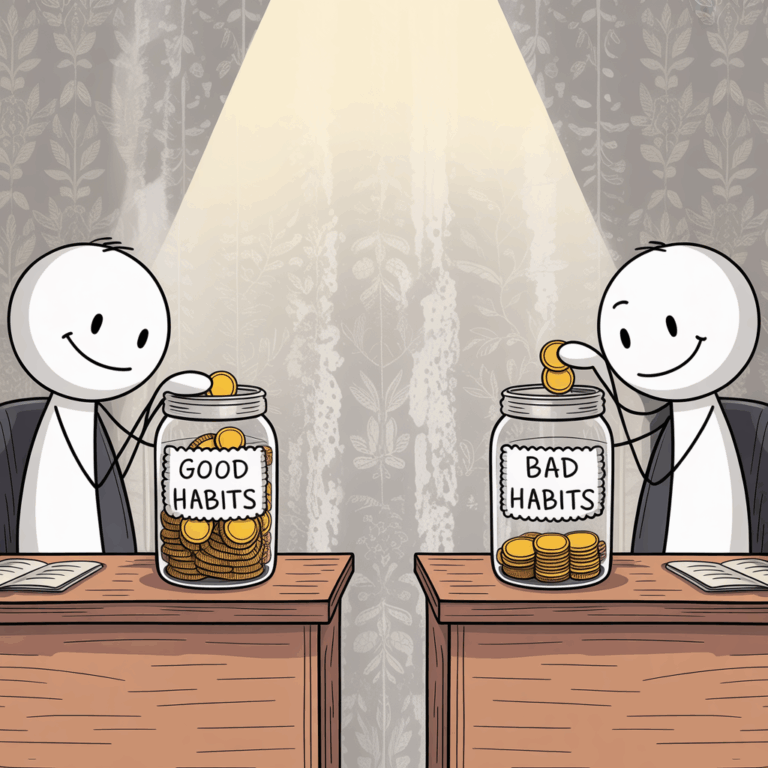
- Financial success is determined by habits.
- It takes about 66 days for a new behavior to become automatic.
- Negotiate daily to build the skill.
- Rich people think differently and avoid complacency.
- Increase your urgency to action by shrinking timelines.
- Your bank account is a direct reflection of how fast you move.
- The speed of a company is constrained by the speed of its CEO.
- Surround yourself with other successful people.
- You are the average of the five people you spend the most time with.
- Economic interconnectedness, the friendship between rich and poor people, impacts future income.
Highlights
"Habits are literally the only thing that can make financial success inevitable.""Everything that you want is on the other side of fear."
"You don't need more friends, you need allies.""If you truly want to change, you need to get to a place that is changed."
"Civilize the mind, make savage the body.""The muse doesn't come to boring people.""Where attention goes, energy flows."
Chapters & Topics
Habit 1: Negotiate Daily
Negotiating daily is a crucial habit for financial success. It’s a skill that needs to be built like a muscle. Rich people negotiate frequently, which helps them avoid complacency and build wealth.
- Keypoints
- Americans are generally awful at negotiating.
- Billionaires negotiate just about anything they can.
- A survey by Coupon Follow found that 69% of millionaires ask for discounts when shopping, compared to only 41% of the general population.
- Thomas Stanley’s book ‘The Millionaire Mind’ states that 94% of millionaires consider negotiation one of the most important skills for building wealth.
- ExplanationForcing yourself to negotiate something each day is a way of telling yourself that you are never truly rich. This mindset prevents complacency and has a compounding impact on your bank account. The first time will feel uncomfortable, but it gets easier. This is a perfect example of the idea that ‘everything that you want is on the other side of fear’.
- ExamplesNoah Kagan, who makes $85 million a year in his company, AppSumo, negotiates his coffee almost every day.
- This small daily habit of asking for a discount on coffee helps him build the muscle for negotiating multi-million dollar SaaS contracts, contributing to his nine-figure-plus net worth.
Habit 2: Increase Your Urgency to Action
This habit involves decreasing the amount of time between having an idea and acting on it. The top 1% understand that urgency is a critical muscle to build for success.
- Keypoints
- Shrink your timelines: push for shorter deadlines (e.g., 60 days instead of a quarter, 2 weeks instead of a month, 24 hours instead of a week).
- Your bank account is a direct reflection of how fast you move.
- The speed of a company is constrained by the speed of the CEO. If you are slow, you can’t expect your team to be faster than you.
- ExplanationBy moving faster than others, you learn more quickly through action and making mistakes. This speed gives you a competitive advantage, even against those who are smarter or richer. The speaker’s companies use a ’24-hour rule,’ replacing ‘next week’ with ’24 hours’ to accelerate progress. If they are six days faster than the average company, they will likely win.
- ExamplesBill Perkins, a hedge fund manager who manages a couple billion dollars, attributes his success not to being smarter, but to moving faster than anyone else.
- By the time somebody has an idea, he has already taken action, done the thing, made three mistakes, and found a better way. He believes people, even if they’re smarter and richer, can’t compete with his speed because he learns so much faster than they do by taking action.
- Considerations
- You’re going to make more mistakes.
- You’re going to have more margin of error.
- Special Circumstances
- If encountering a situation where you are the fast, vision-oriented person, how should it be addressed? It’s beneficial to have a partner (like a COO or CFO) who is more detail-oriented and risk-focused to act as a ‘collar’ and provide balance.
Habit 3: Surround Yourself with Other Winners
Make a habit of associating with people who are more successful than you. You need allies who push you to keep going, not just friends who want you to stay the same.
- Keypoints
- 79% of wealthy people network for at least five hours each month, whereas only 16% of the poorer population engage in networking activities.
- The cliche ‘you are the average of the five people you spend the most time with’ is very true.
- Staying in your hometown and with your same peer group is likely keeping you poor.
- Economic interconnectedness, which measures how many rich and poor people are friends, is a strong predictor of future income.
- ExplanationThe people you surround yourself with have a significant impact on your success. Being around successful people provides you with models to learn from and allies to support your growth. Leaving your comfort zone and hometown can be necessary for change and growth. A study on ‘economic interconnectedness’ followed kids from families with similar lower incomes. The kids who grew up in towns with more rich people around them went on to earn 33% more by age 35. This shows that the socioeconomic status of your family is not the only indicator of your future income; the connectedness between different social income levels is also crucial.
- ExamplesA small group of friends who created PayPal went on to create other major companies like Tesla, SpaceX, LinkedIn, YouTube, Yelp, and Palantir, with a combined value of over $1 trillion.
- This group of less than 20 individuals, who may have started as ‘nerds’ in high school, focused intensely and surrounded themselves with other hardcore, focused people, leading to immense collective success.
Cody Sanchez wanted to learn about the media business from Sam Parr, founder of The Hustle. She found out Sam’s favorite candy was Butterfingers and sent a large, ‘obnoxious size’ box of them to his office with a note.
- This unusual gesture, costing about $30, started a conversation. Over the years, Sam Parr provided the playbook for starting a newsletter business, and they have collaborated on podcasts. This demonstrates a creative and effective way to get in front of successful people.
Habit 4: Read for Self-Improvement
The wealthiest people make a habit of reading daily for education and self-improvement, with a focus on books, especially biographies of successful individuals.
- Keypoints
- 88% of the wealthiest people spend at least 30 minutes a day reading for education or self-improvement.
- Approximately 60% of wealthy people listen to audiobooks during their commute.
- Biographies of billionaires are the very blueprints on how to get rich.
- ExplanationTo achieve a certain level of success, such as building a billion-dollar company, you should study those who have already done it by reading their biographies and books. This allows you to ‘copy the top 1%’ and learn from their experiences. Turning commute time into learning time with audiobooks is an efficient way to apply this habit.
- ExamplesCody Sanchez recommends several books: ‘Built from Scratch’ (Home Depot founders), ‘Poor Charlie’s Almanack’ (Charlie Munger), ‘The Ride of a Lifetime’ (Bob Iger), ‘Steve Jobs’ and ‘Elon Musk’ (by Walter Isaacson), ‘Made in America’ (Sam Walton), and ‘Am I Being Too Subtle’ (Sam Zell). She also promotes her own book, ‘Main Street Millionaire’.
- These books provide the stories and strategies of billion-dollar company founders and investors. By reading them, you can ‘steal their homework’ and apply their principles to your own journey.
Early in her career, Cody read ‘The Adventure Capitalist’ by Jim Rogers. The book described how he traveled the world and invested in third-world countries after co-founding a successful hedge fund with George Soros.
- This book changed Cody’s worldview, showing that it was possible to live an adventure-filled life while also achieving significant financial success. It inspired her to find a way to combine her finance skills with her desire to live and work in Latin America, ultimately leading her to run a billion-dollar asset management fund group there.
Habit 5: Use a To-Do List and Prioritize
Wealthy people consistently use to-do lists and focus on a small number of critical goals. The key is to identify and complete the single most important task first each day, a concept from the book ‘The One Thing’.
- Keypoints
- About 81% of wealthy people maintain a to-do list, compared to only 19% of poor people.
- 80% of the wealthy are focused on accomplishing one single goal or three to five top goals, compared to only 12% of the poor.
- The goal is to have one thing on your calendar each day that, if accomplished, makes everything else easier or irrelevant.
- Cody Sanchez is not allowed to go to sleep until her ‘one thing’ is finished.
- ExplanationInstead of a long, overwhelming to-do list, you should identify the ‘one thing’ that, if accomplished, makes everything else on your list easier or irrelevant. This ‘one thing’ is a non-negotiable daily task. To identify it, ask yourself questions like, ‘What on this list, if I do it, makes everything else easier?’ or ‘What on this list, if I do it, makes other things unnecessary to do?’
- ExamplesAn example of a ‘one thing’ could be hiring a new video editor.
- If you hire a video editor, all the subsequent tasks like editing, uploading, and color grading videos become unnecessary for you to do. This single action makes other tasks irrelevant and frees up your time.
Habit six: Saving
Get in the habit of saving. The biggest determinant for those who create wealth versus those always stuck chasing their next paycheck is the ability to refrain from spending everything you earn. 94% of wealthy people save 20% or more of their income, while only 5% of poor people do the same.
- Keypoints
- When you get in the habit of saving, the game changes.
- You’ll never be wealthy if your lifestyle matches your paycheck.
- The magic of compounding means that every dollar you save and reinvest starts to grow over time, to the point where your money can work harder, faster, and longer than you.
- You can’t save your way to being rich; the way to become truly rich is to earn more. You must learn not to spend more just because you make more.
- ExplanationTo build the habit of saving, the speaker suggests three rules: 1. Automatically put money into savings accounts so you never touch it. 2. Never buy to impress; it’s okay to want to look nice, but don’t be stupid with money. 3. Reward yourself for the action you don’t want to take. For instance, if you want to save an extra $1,000 a month, reward yourself with something (a book, a new shirt, a date night) once you hit that goal. This creates a positive reward cycle. Additionally, track your bank account daily to keep it top of mind, because ‘where attention goes, energy flows’.
Habit seven: Create always better than consume
The wealthiest people tend to spend more time creating rather than consuming. A demonstrative statistic is that 67% of the wealthiest people watch one hour or less of TV daily, while 77% of those struggling financially spend an hour or more watching TV a day.
- Keypoints
- When you wake up, do not engage in social media, email, or texting. Instead, write or create something before you get sucked into consumption.
- To develop a creator mindset, you should only use other people’s creations to spark your own creations.
- The muse doesn’t come to boring people; you need to find inspiration.
- ExplanationTo get in the zone to create, the speaker suggests creating an inspiring environment with music, the right lighting, and a candle. Read inspiring material (the speaker mentions Jonah Goldberg) to spark your own ideas. It’s crucial to shift from ‘problem mode’ to ‘creation mode’ by focusing on inspiration rather than what’s not working. To limit social media consumption, Cody uses three tools: 1. Tracking screen time on her phone with a daily goal. 2. Using a device that shuts off the Wi-Fi at night (e.g., after 10 p.m.). 3. Having an accountability partner (her husband) to keep her off her phone in the morning.
Habit eight: Fitness
The wealthiest people recognize the importance of making a habit of physical movement every day because how your brain functions is intrinsically linked to your physical health. It’s noted that 76% of the wealthiest people exercise at least four days a week, compared to only 23% of the poorest population.
- Keypoints
- Cody’s phrase is, ‘Civilize the mind, make savage the body’.
- Fitness doesn’t have to be intense, but it has to be consistent.
- A famous Peter Drucker quote: ‘What gets measured gets managed’. The speaker uses the Streaks app to track her workouts.
- What gets planned gets prioritized. Put your workouts on your calendar.
- The speaker’s ‘lazy girl guide to fitness’ consists of: 1. Achieving 10,000 steps a day. 2. Doing a cold plunge. 3. Lifting weights 3-4 days a week using the Ladder app for programming.
- ExplanationTo fit fitness into a busy schedule, you must plan and prioritize it by putting it on your calendar. Using an app like Streaks can help with motivation through gamification. Sanchez reminds herself of the principle ‘Choose your hard,’ explaining that being unfit is hard in its own ways (e.g., health, relationships, making less money due to attractiveness privilege), just as being fit is hard. Her personal ‘lazy girl guide to fitness’ involves getting 10,000 steps a day (using a $200 Desky treadmill), doing cold plunges, and lifting weights three or four times a week with programming from the Ladder app.
Habit nine: Wake-up time
Waking up early is directly correlated with being wealthy. Cody finds that waking up at 5:45 a.m. solves 99.9% of her daily issues. Data shows that 44% of wealthy individuals wake up three hours before their workday begins, compared to only 3% of those in lower-income brackets. This allows you to carve out time for yourself before work begins.
- Keypoints
- Waking up early helps you avoid poor decisions often made late at night, such as eating, drinking, or staying out too late.
- If you are a ‘night owl’, a 2017 Harvard study suggests that consistency in your wake-up time is more important than the specific time itself. Waking up at the same time every day, including weekends, can make you more productive.
- ExplanationTo make waking up early a habit, Sanchez suggests getting an accountability partner, such as a friend or spouse, to schedule early morning activities with (e.g., a 6 a.m. yoga class). Her husband serves as her accountability partner. The key is not just getting up early but also avoiding staying up late, reinforcing the idea that ‘nothing good happens after midnight’.
Assignments & Suggestions
- Negotiate the price of something almost every day.
- Learn how to buy a business, even if you are not going to buy one.
- The next time you are buying something, ask if you can have a discount.
- When you say next quarter, push for 60 days. When you say next month, push for two weeks. When you say next week, push for 24 hours.
- Every time you think one week, instead replace it with 24 hours.
- You should try to get around people that either have the life that you want or have skills you want to learn.
- Never be afraid to leave your hometown to grow.
- Focus on less things.
- Have one thing on your to-do list each day where if you accomplish that one thing, everything else in your day either gets easier or irrelevant.