The E-Myth
🛋️ Who Should Read The E-Myth
The E-Myth Revisited is essential for anyone who dreams of running a business that works for them — rather than the other way around. You’ll benefit most from this book if you are:
- 🚀 Aspiring entrepreneurs – If you’re thinking about starting a business, this book will help you avoid common pitfalls from day one.
- 🏪 Small business owners – Especially if you feel overwhelmed, overworked, and stuck “doing everything yourself.”
- 💻 Freelancers and solopreneurs – A roadmap for building systems so you can scale beyond trading time for money.
- 📋 Managers in growing companies – Learn how to structure workflows, delegate effectively, and create repeatable processes.
- 🏆 Future franchise owners – Understand why systems matter and how successful franchises thrive.
If you’ve ever thought, “My business would fall apart if I stepped away for a week,” 🛑 this book is your wake-up call.
📃 Summary of The E-Myth
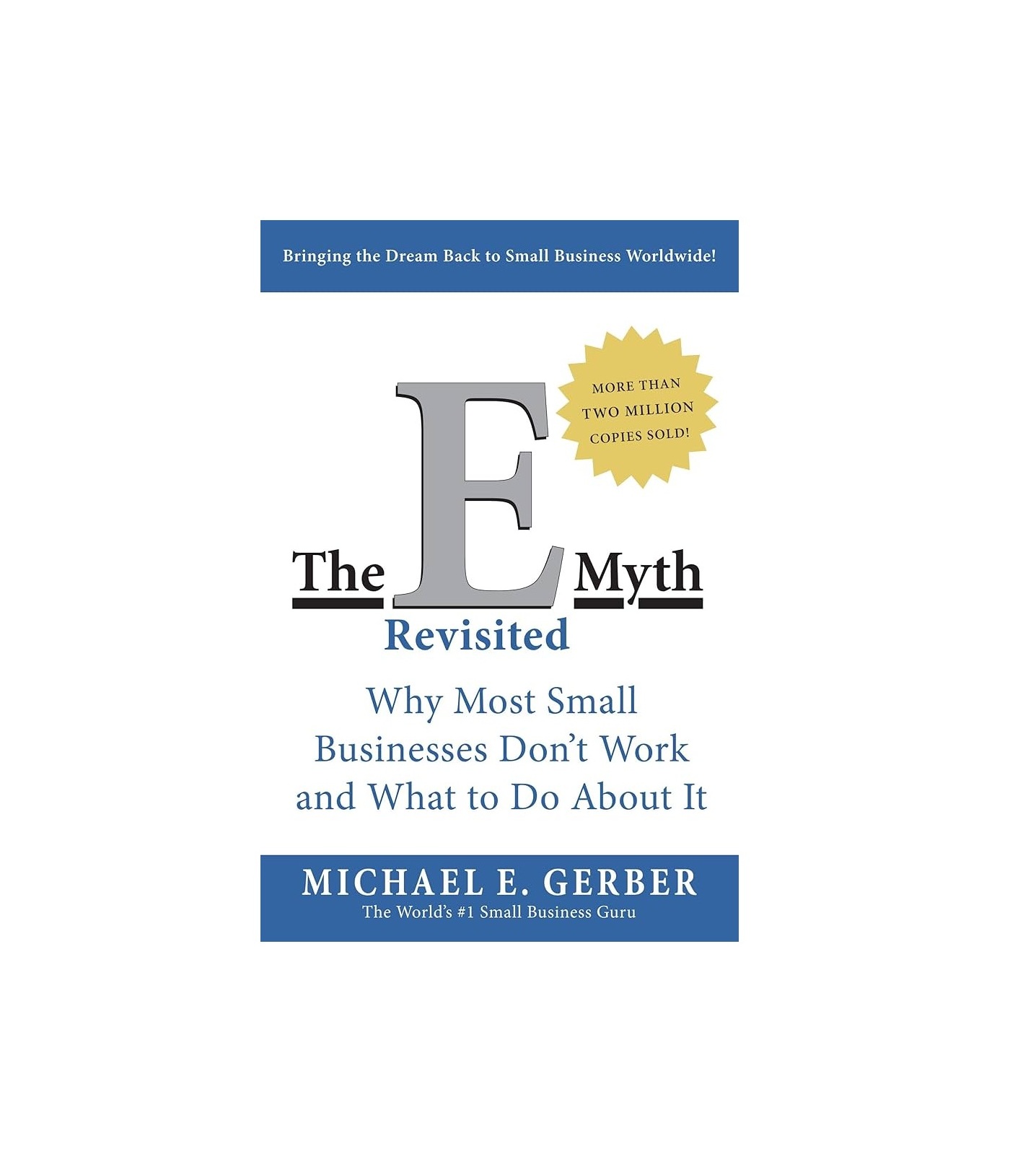
Michael E. Gerber’s The E-Myth Revisited is a powerful exploration of why so many small businesses fail and how entrepreneurs can design their companies to succeed. At its core, the book challenges the “entrepreneurial myth” — the belief that most people start businesses because they’re true entrepreneurs. In reality, many are skilled technicians who get caught in the “Fatal Assumption”: that understanding the technical work of a business means they understand how to run that business.
Gerber introduces three distinct roles every business owner must play: the Technician, who does the work; the Manager, who organizes it; and the Entrepreneur, who envisions the future. Most small business owners spend almost all their time as Technicians, buried in day-to-day tasks, leaving little space for strategic growth. The key, Gerber argues, is shifting to work on your business instead of being trapped in it.
He illustrates these lessons through relatable storytelling, particularly the fictional example of Sarah, who loves baking pies but becomes overwhelmed when her bakery consumes her life. Sarah’s journey reflects the reality for many owners — passion alone cannot build a sustainable business. The turning point comes with the concept of the “Franchise Prototype” — designing your business so it could be replicated consistently, just like McDonald’s delivers the same experience every time, no matter who runs the counter.
This approach depends on creating systems, documenting processes, and eliminating guesswork. Every task, from customer service to product delivery, should be orchestrated so that the results are consistent, predictable, and not dependent on any one person. Systems free the owner from being the business’s bottleneck and ensure the company can grow without sacrificing quality.
Marketing also plays a central role. Gerber stresses that effective marketing starts and ends with the customer — not the owner’s personal preferences. Understanding your customer’s wants, needs, and motivations (both demographics and psychographics) allows you to build products, services, and experiences that keep them coming back. Consistency is key; customers return to businesses that deliver exactly what they expect every time.
Beyond systems and marketing, Gerber reframes the purpose of business itself. A business, he says, should serve your life — not consume it. This means building a company that supports your goals, values, and freedom, rather than chaining you to endless hours of work. With a well-designed structure, the owner becomes a leader and strategist rather than the sole laborer, able to focus on growth and innovation.
By the end of The E-Myth Revisited, it’s clear that the path to lasting success isn’t found in working harder, but in designing smarter. With the right mindset, well-documented systems, a customer-first approach, and a commitment to consistent execution, any small business can transform into an organization that thrives without constant owner involvement. Gerber’s message is both practical and liberating: you can build a business that works for you, giving you the time and freedom to live the life you actually want.
👌🏻 Takeaways from The E-Myth
🍔 McDonald’s as a Model of Excellence
- Better than just about any business in the world, McDonald’s, the love of Ray Kroc’s life, still keeps its promise, long after Ray Kroc has gone. It delivers exactly what we have come to expect of it every single time.
- McDonald’s has not only created an extraordinary business, it has created for all of us small business owners an extraordinary way to create an extraordinary business. It has created a model we can emulate.
- The model will be operated by people with the lowest possible level of skill.
🤝 Integrity & Consistency
- And to me, that’s what integrity is all about. It’s about doing what you say you will do, and, if you can’t, learning how.
- The barber experience:
- There was absolutely no consistency to the experience.
- Business for him not for me.
- “Burnt Child” Syndrome. This is where a child is alternately punished and rewarded for the same kind of behavior… It can also be disastrous to the customer.
- What you do in your model is not nearly as important as doing what you do the same way, each and every time.
- Different consumer groups simply respond differently to specific colors and shapes. Believe it or not, the colors and shapes of your model can make or break your business!
📄 Documentation & Order
- All work in the Model Will be Documented in Operations Manuals:
- Without documentation, all routinized work turns into exceptions.
- Documentation provides your people with the structure they need and with a written account of how to “get the job done” in the most efficient and effective way.
- It communicates to the new employees, as well as to the old, that there is a logic to the world in which they have chosen to work, that there is a technology by which results are produced. Documentation is an affirmation of order.
🎯 Orchestration & Franchise Thinking
- Orchestration is the elimination of discretion, or choice, at the operating level of your business.
- Without Orchestration, nothing could be planned, and nothing anticipated by you or your customer. If you’re doing everything differently each time… you’re creating chaos.
- If you haven’t orchestrated it, you don’t own it!
- And if you don’t own it, you can’t depend on it.
- And if you can’t depend on it, you haven’t got a franchise.
- And without a franchise no business can hope to succeed.
- In short, the definition of a franchise is simply your unique way of doing business.
- And unless your unique way of doing business can be replicated every single time, you don’t own it.
- You have lost it. And once you’ve lost it, you’re out of business.
- Because unless your customer gets everything he wants every single time, he’ll go someplace else to get it!
- Orchestration is the glue that holds you fast to your customers’ perceptions.
- Orchestration is the certainty that is absent from every other human experience. It is the order and the logic behind the human craving for reason.
- Orchestration is as simple as doing what you do, saying what you say, looking like you look—being how and who you are—for as long as it works.
- For as long as it produces the results you want.
- And when it doesn’t work any longer, change it!
🗂 Organization & Structure
- What Jack and Murray don’t understand is that without an Organization Chart, everything hinges on luck and good feelings, on the personalities of the people and the goodwill they share.
🔄 Systems Thinking
- A system is a set of things, actions, ideas, and information that interact with each other, and in so doing, alter other systems.
- The 20 percent are using a system, and the 80 percent aren’t.
🌍 Perspective & Responsibility
- The world’s not the problem; you and I are. The world’s not in chaos; we are. The world’s apparent chaos is only a reflection of our own inner turmoil.
🗣️ Quotes from The E-Myth
📉 Business Growth & Decline
- “In short, businesses that get small again die”
- “If your business depends on you, you don’t own a business—you have a job”
- “A business that could work without him”
🗺 Planning & Vision
- “Any plan is better than no plan”
- “Because in the process of defining the future, the plan begins to shape itself to reality, both the reality of the world out there and the reality you are able to create in here.”
- “They see the pattern, understand the order, experience the vision”
- “In a world of chaos, most people crave order”
- “Freedom does not come automatically; it is achieved. And it is not gained in a single bound; it must be achieved each day.”
- “You should know now that a man of knowledge lives by acting, not by thinking about acting, not by thinking about what he will think when he has finished acting. A man of knowledge chooses a path with heart and follows it.”
- “The key is to plan, envision, and articulate what you see in the future… if you don’t articulate it—you don’t own it!”
🛠 Systems & Structure
- “Systems theory looks at the world in terms of the interrelatedness of all phenomena…”
- “A systems-dependent business, not a people-dependent business”
- “How can I create a business whose results are systems-dependent rather than people-dependent?”
- “Therein lies the secret behind the stunning success of the Business Format Franchise… That secret is the Franchise Prototype”
- “The Franchise Prototype provides the means through which the small business owner can feed his three personalities in a balanced way while creating a business that works.”
- “All organizations are hierarchical. At each level people serve under those above them. If it is not structured, it is a mob.”
- “If everybody’s doing everything, then who’s accountable for anything?”
🧠 Mindset & Leadership
- “Tolerance for failure is a very specific part of the excellent company culture… Champions have to make lots of tries and consequently suffer some failures or the organization won’t learn.”
- “The business is not your life: Once you recognize that the primary purpose of your business is to serve your life, you can work on it with clarity.”
- “The difference between great people and everyone else is that great people create their lives actively, while everyone else is created by their lives.”
- “Working on your business, not in your business, is the key to building systems that empower growth.”
📢 Marketing & Customers
- “Your Marketing Strategy starts, ends, lives, and dies with your customer.”
- “When it comes to marketing, what you want is unimportant”
- “And what your customer wants is probably significantly different from what you think he wants.”
- “If you know who your customer is—demographics—you can then determine why he buys—psychographics.”
- “Forget about everything but your customer!”
- “Most people today are not getting what they want… Something is missing—purpose, values, a game worth playing.”
📒 Why This Book Works
Michael E. Gerber’s The E-Myth Revisited stands out because it doesn’t just offer business tips — it rewires the way you think about business entirely. Here’s why it’s so effective:
- 🔄 It flips your perspective – Instead of being trapped “working in” your business, you learn to “work on” it, building a company that runs without constant owner intervention.
- 🛠 Actionable frameworks – Concepts like the Franchise Prototype and systems-dependent business are practical, not just theoretical, making them easy to apply immediately.
- 💡 Mindset + method – It balances mindset shifts (entrepreneur, manager, technician) with tangible steps to implement those shifts.
- 📖 Relatable storytelling – Gerber uses simple, memorable examples (like the story of Sarah and her pie shop) to make complex business ideas stick.
- 🏗 Built for any stage – Whether you’re launching your first venture or restructuring an existing one, its principles scale with you.
- 🚦 Clear warning signs – It shows you exactly how to spot early danger signals before your business burns you out or fails.
At its core, The E-Myth Revisited works because it’s not about running a business — it’s about designing a business that works for you.
🧬 How The E-Myth Changed My Life
Before reading The E-Myth Revisited, I saw business ownership as something you had to give your entire life to — late nights, endless stress, and doing everything yourself. At the time, I was already balancing a full-time job and teaching part-time, so the idea of starting a business felt impossible.
But Michael Gerber’s message flipped that belief on its head. I learned that a business doesn’t have to rely on me doing all the work — it can be designed to run on systems, not my constant presence. The concept of working on the business, not in it made me realize that I could create something scalable, predictable, and self-sustaining.
That’s when I decided to take the leap. I opened my own business — and from day one, I built it with automation, clear processes, and the goal of making it function without me being there every second. Now, my business grows while I still enjoy my career and my teaching.
This book didn’t just inspire me to start a business — it showed me how to design one that gives me freedom instead of taking it away.
💭 Final Thoughts
The E-Myth Revisited isn’t just another business book — it’s a mindset shift, a blueprint, and a reality check all in one. It teaches you that success doesn’t come from working harder, but from designing systems, processes, and structures that work without you.
Whether you’re a dreamer with a business idea, a burned-out owner drowning in daily tasks, or someone who simply wants more freedom, Gerber’s lessons apply. The power of this book lies in its ability to make you step back, see the bigger picture, and build a business that serves your life — not the other way around.
In the end, the real magic of The E-Myth Revisited is that it doesn’t just change the way you run a business… it changes the way you think about work, time, and freedom.