Physical Address
304 North Cardinal St.
Dorchester Center, MA 02124
Physical Address
304 North Cardinal St.
Dorchester Center, MA 02124

This book is ideal for:
If you’re questioning the traditional “work hard, get paid, retire” model, this book is for you.
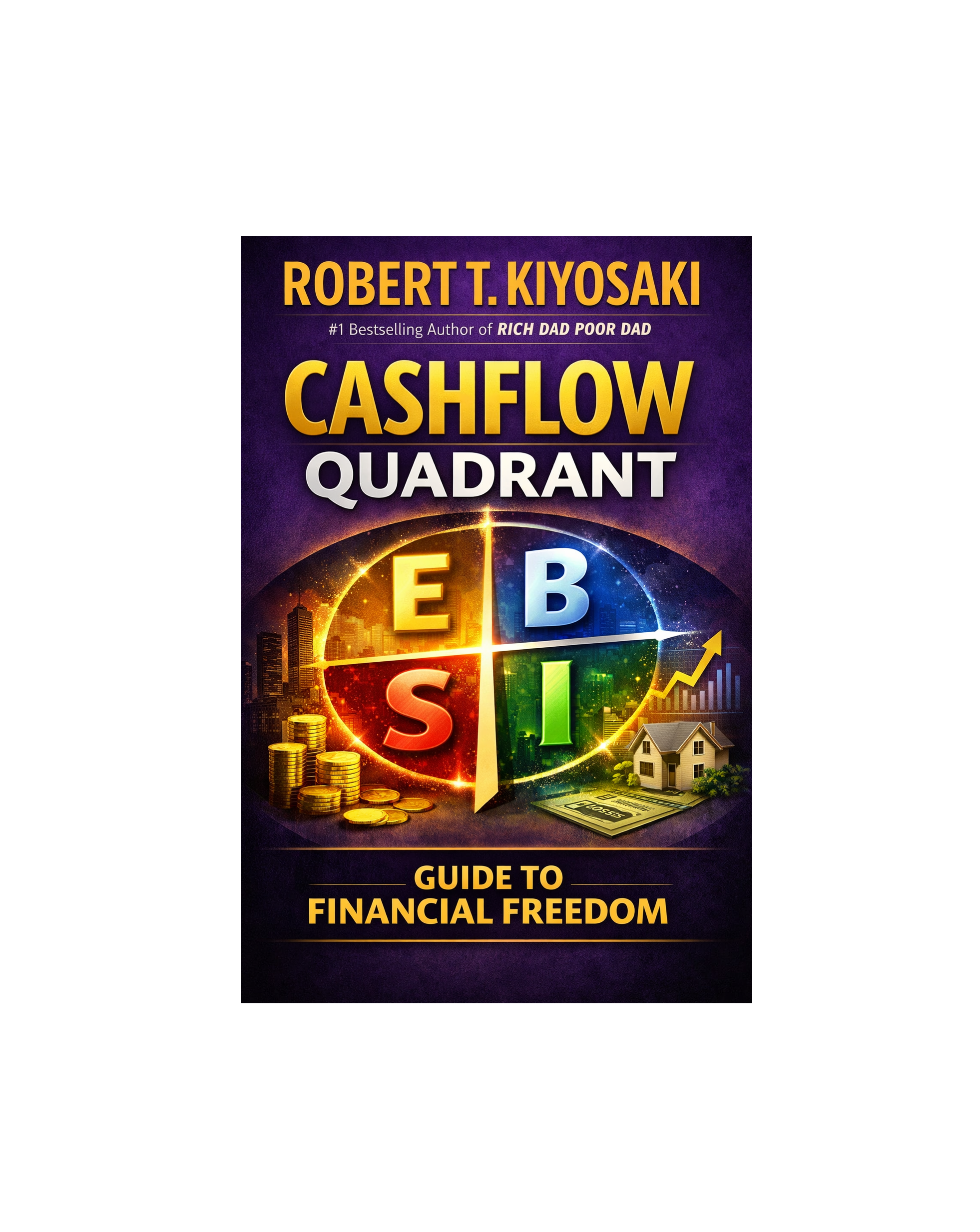
In Cashflow Quadrant, Robert T. Kiyosaki expands on the ideas introduced in Rich Dad Poor Dad and presents a framework that explains how people earn money, why they think differently about work and wealth, and how financial freedom is actually achieved. The core idea of the book is that where your income comes from matters more than how much you earn.
Kiyosaki introduces the Cashflow Quadrant, which is divided into four categories representing different ways people generate income:
Each quadrant represents not only a source of income, but also a mindset, skillset, risk tolerance, and lifestyle.
Employees (E) work for security. They trade time for money, rely on a paycheck, and depend on benefits such as healthcare or pensions. Their income is stable but limited, and they are often heavily taxed.
Self-employed individuals (S) own their job. Doctors, lawyers, consultants, freelancers, and small business owners often fall into this category. While they may earn more than employees, their income still depends entirely on their presence. If they stop working, the income stops.
Business owners (B) build systems that work without them. They create businesses that can operate through employees, processes, and automation. Their goal is scalability and leverage, not personal effort.
Investors (I) make money through assets. Their money works for them by generating passive income through stocks, real estate, businesses, or other investments.
Kiyosaki emphasizes that financial freedom is achieved primarily in the B and I quadrants, where income is not directly tied to time worked.
According to Kiyosaki, society conditions people from a young age to seek job security. Schools train students to become good employees by following rules, avoiding mistakes, and memorizing information rather than developing financial intelligence.
Fear plays a major role:
These fears keep people stuck in the Employee or Self-Employed quadrants, even if they are unhappy or financially stressed. Kiyosaki argues that true security does not come from a job, but from financial education and the ability to adapt.
A key message in the book is that high income does not equal wealth. Many professionals earn large salaries yet remain financially vulnerable because they rely on earned income.
Financial freedom, as defined by Kiyosaki, is reached when:
Passive income from investments exceeds living expenses.
This means you no longer need to work to survive. Work becomes optional, not mandatory.
Kiyosaki stresses that the biggest obstacle to moving quadrants is mindset, not money or intelligence.
People in each quadrant think differently:
Moving from the left side (E/S) to the right side (B/I) requires a mental shift:
Kiyosaki explains that mistakes are not something to fear, but something to learn from, especially in business and investing.
A major theme of the book is that financial literacy is more important than academic education when it comes to wealth.
Kiyosaki highlights key financial skills:
He criticizes the education system for failing to teach these fundamentals and encourages readers to educate themselves continuously through books, mentors, and real-world experience.
One of the most eye-opening parts of the book is the explanation of how taxes favor the B and I quadrants.
Employees and self-employed individuals are taxed first and paid later. Business owners and investors are often paid first and taxed later, benefiting from deductions, depreciation, and legal structures.
Kiyosaki emphasizes that:
Kiyosaki makes a clear distinction between owning a job and owning a business. Many people believe they are business owners when in reality, their business cannot function without them.
A true business owner:
This transition requires learning leadership, delegation, and system-building — skills that many self-employed people resist because they want control.
Kiyosaki strongly rejects the idea that investing is risky by nature. Instead, he argues that lack of knowledge is the real risk.
He divides investors into categories:
The goal is to become an informed investor who understands:
Investing, in Kiyosaki’s view, is a learned skill that improves with experience and education.
A recurring theme is personal responsibility. Kiyosaki encourages readers to stop blaming:
Instead, he urges readers to take control of their financial future by choosing education, discipline, and long-term thinking.
The book concludes by reinforcing that wealth is not about luxury, status, or material possessions. True wealth is:
Kiyosaki frames money as a tool, not a goal. The Cashflow Quadrant is simply a map — the journey depends on the reader’s willingness to learn, take risks, and grow.
Cashflow Quadrant is a blueprint for understanding money at a deeper level. It doesn’t promise instant results, but it offers a framework that can permanently change how you think about income, work, and wealth.
The book’s power lies not in tactics, but in its ability to reprogram financial thinking — making it a cornerstone for anyone serious about long-term financial independence.
The quadrant framework is easy to remember and powerful enough to change how you view money forever.
This book forces you to reflect on where your income truly comes from and whether it aligns with your long-term freedom. It changes the question from:
“How can I earn more money?”
to
“How can I stop trading time for money?”
It pushes you to think in terms of ownership, leverage, and systems, not just effort. Even if you don’t immediately move quadrants, your decisions start aligning with a bigger financial vision.
Cashflow Quadrant isn’t about getting rich quick — it’s about thinking rich correctly.
It’s a mindset shift that can feel uncomfortable, but that’s exactly why it’s effective.
If you’re serious about long-term wealth, freedom, and control over your time, this book is not optional — it’s foundational.