Physical Address
304 North Cardinal St.
Dorchester Center, MA 02124
Physical Address
304 North Cardinal St.
Dorchester Center, MA 02124

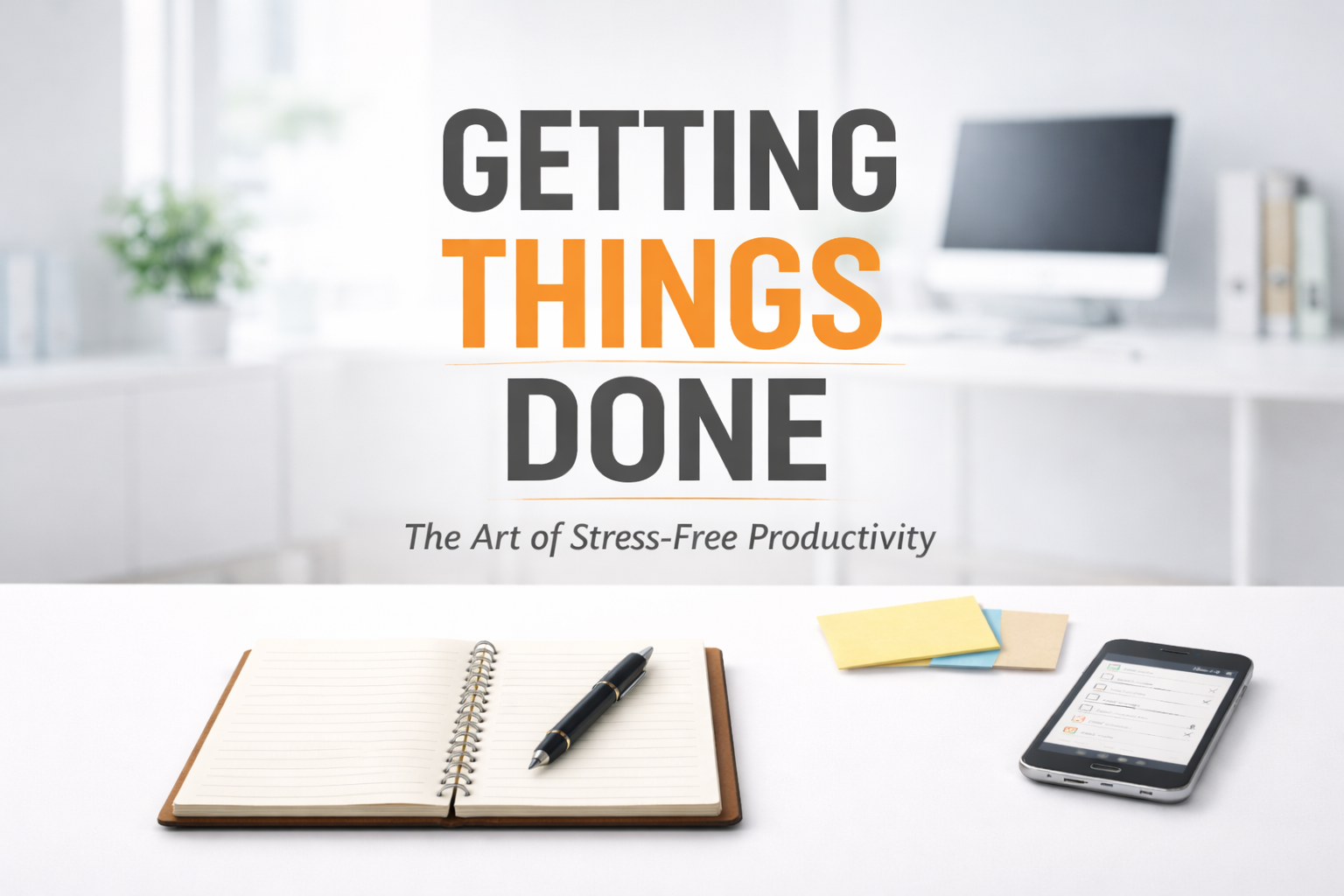
Getting Things Done is for anyone who feels perpetually overwhelmed — the professional juggling dozens of projects, the student drowning in deadlines, or the parent trying to keep the household running while holding down a career. If you’ve ever gone to bed with a nagging sense that something important slipped through the cracks, this book was written for you.
It’s especially valuable for knowledge workers, freelancers, managers, and creatives who deal with ambiguous, open-ended work rather than simple checklists. That said, the system David Allen describes is flexible enough to work for almost anyone willing to invest the time to set it up properly.
Getting Things Done (commonly known as GTD) is a productivity system built around a single core insight: your mind is for having ideas, not holding them. David Allen argues that most of our stress and mental fog comes not from having too much to do, but from trying to keep track of everything in our heads.
The GTD method is built on five steps: Capture everything that has your attention into a trusted system; Clarify what each item means and what action it requires; Organize the results into the right categories and lists; Reflect on your system regularly to keep it current; and Engage — actually do the work with confidence that you’re choosing the right task at the right time.
Allen introduces several powerful concepts along the way, including the “two-minute rule” (if something takes less than two minutes, do it now), the “next action” principle (always define the very next physical step for any project), and the idea of “contexts” (grouping tasks by where or how they can be done — at a computer, on the phone, while running errands).
The book isn’t just about time management. It’s about achieving what Allen calls “mind like water” — a calm, clear mental state where you’re fully present and responsive, rather than reactive and scattered.
Your brain is a bad filing cabinet. Keeping tasks in your head creates low-level anxiety and cognitive drag. Moving everything into an external, trusted system frees up mental bandwidth for actual thinking.
Define “done” and define “next.” Two questions that cut through procrastination: What does finished look like? What’s the very next physical action? Vague projects stall. Clear next actions move.
The two-minute rule is deceptively powerful. Small tasks pile up faster than you think. If something takes less than two minutes, doing it immediately is almost always more efficient than deferring it.
Weekly reviews are non-negotiable. The system only works if you maintain it. A weekly review — processing inboxes, reviewing projects, updating lists — keeps everything trustworthy and current.
Context matters more than priority. You can’t write a report on your phone while waiting for the dentist. Organizing by context (phone, computer, home, errands) means you always know what’s actually doable in any given moment.
“Your mind is for having ideas, not holding them.”
“If you don’t pay appropriate attention to what has your attention, it will take more of your attention than it deserves.”
“You can do anything, but not everything.”
“Much of the stress that people feel doesn’t come from having too much to do. It comes from not finishing what they’ve started.”
“There is no reason to ever have the same thought twice, unless you like having that thought.”
Most productivity books give you motivational frameworks or vague advice about “prioritizing what matters.” Getting Things Done goes further — it gives you an actual operational system with specific tools, workflows, and habits.
What makes GTD hold up decades after its original publication is that it’s built on psychological reality, not wishful thinking. Allen understands that willpower is finite, that context shapes what’s possible, and that an untrusted system is no system at all. The methodology accounts for how humans actually think and work, not how we wish we did.
It also scales. Whether you’re a solo freelancer with a single inbox or an executive managing five departments, the core principles apply. The system adapts to you rather than forcing you into a rigid structure.
Before GTD, I was a collector of good intentions. I had sticky notes on my monitor, half-finished to-do lists in three different apps, and a persistent background hum of anxiety that I was forgetting something important. Productivity felt like running on a treadmill — lots of motion, no real progress. After implementing the GTD system, the first thing I noticed wasn’t that I got more done. It was that I stopped worrying. When every open loop — every “I should really do this someday” and “don’t forget to follow up on that” — had a home in a trusted system, my mind quieted down. The weekly review became a ritual I actually look forward to. The next action habit changed how I approach any project. And the simple act of writing things down, really writing them down into a system I trust, turned out to be more powerful than any app or hack I’d ever tried. GTD didn’t just organize my tasks. It changed how I think about work.
Getting Things Done is one of those rare books that earns its reputation. It’s not a quick read or a simple fix — implementing GTD properly takes real effort upfront. But the payoff is a fundamentally different relationship with your work and your time.
If you’ve ever felt like you’re constantly reacting instead of intentionally acting, this book offers a way out. It won’t tell you what to do with your life, but it will clear the mental clutter so you can finally figure that out for yourself.
Start with the capture habit. Work your way into the full system at your own pace. And don’t skip the weekly review — that’s where the magic actually lives.